
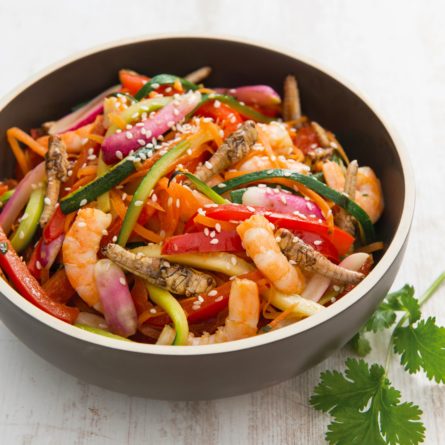
Homemade honey-mustard sauce comes together in 5 minutes with 4 ingredients: honey, mustard, oil and vinegar. It works just as well on a salad as on a duck breast, a roast chicken, a poke bowl or… our grilled Jimini’s crickets 🦗.
At Jimini’s, people ask us all the time for the real recipe behind our honey-mustard sauce. So here’s the confession: the big secret? there isn’t one. Just good ingredients, the right gesture, and 5 minutes flat. We’ll walk you through everything, plus the 3 variants that actually shift the game (warm version, balsamic, creamy), and the 3 mistakes that split your emulsion.
Prep time: 5 minutes · Cook time: 0 minutes · Serves 2 · Difficulty: very easy · Cost: under £1 / €1 per serving
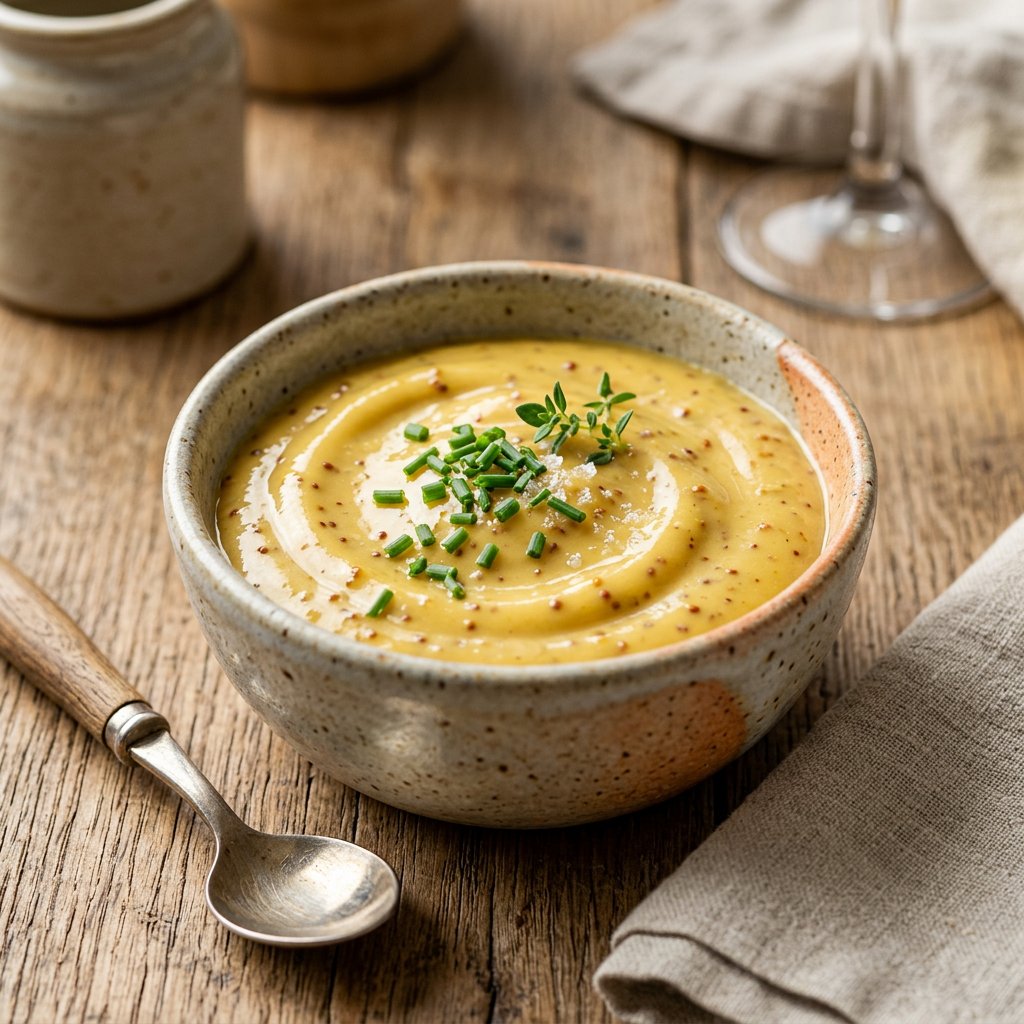
Ingredients for 2 servings
Four core ingredients, three odds and ends. That’s it.
The essentials
- 2 teaspoons honey (forest honey ideally — see “Choosing the honey” below)
- 1 teaspoon mustard (strong Dijon PGI recommended)
- 2 teaspoons oil (hazelnut, fruity olive or deodorised rapeseed)
- 1 dash balsamic vinegar (about ½ teaspoon)
The finishing touches
- A few sprigs of fresh chives, finely chopped
- Fine salt and freshly cracked pepper
- (Optional) A pinch of flaky sea salt at plating
Equipment
- A small bowl or a screw-top jar (ideal for emulsifying by shaking)
- A mini-whisk or a fork
- A measuring spoon
Choosing the honey (it really matters for flavour)
Our go-to: a forest honey from the Paris region. Under the PGI (Protected Geographical Indication) specification, the “forest honey” label guarantees a woodland origin and a higher mineral content (iron, magnesium) than a standard multi-flower honey (Source: INAO — the French food-origin authority, PGI honey specification, 2022). The result is more complex, with a woody note that holds its own against the mustard.
An acacia honey will give a softer, almost floral sauce — perfect for crudités salads. A classic multi-flower honey will do the daily-driver job, but it won’t quite sing alongside a duck breast.
Choosing the mustard
- Strong Dijon mustard (PGI): the most balanced — our default pick.
- Wholegrain mustard: brings visual crunch (whole seeds), perfect for a chef-style plating.
- Sweet US-style mustards (already blended with honey): avoid — too sweet, they saturate the palate once combined with our own honey.
Method in 5 steps (5 minutes flat)
The logic is simple: you combine the liquid base first, emulsify by adding the oil last, season, snip the chives, serve. Here’s the step-by-step.
- Combine honey and mustard. In a small bowl, add the 2 teaspoons of honey and the 1 teaspoon of mustard. Whisk with a mini-whisk until you get a smooth, uniform paste. That’s the backbone of the emulsion — if the honey has crystallised, warm it for 10 seconds in a bain-marie before adding the mustard.
- Add the balsamic vinegar. Pour in the dash of balsamic (½ teaspoon). Whisk again. The acidity cuts through the honey’s sweetness and lifts the aromatics. It also plays the role of a natural preservative: the sauce becomes acidic enough that bacteria don’t thrive (pH below 4.5).
- Stream in the oil. Pour the 2 teaspoons of oil in slowly, whisking without stopping. This is the key step: the mustard is the emulsifier, grabbing the oil and pulling it into suspension. Pour it all at once and the sauce will split.
- Season and taste. A pinch of fine salt, a grind of pepper. Taste it. Too sweet? Add a few drops of vinegar. Too bitter? Add ½ teaspoon of honey. The perfect balance is made on the tongue.
- Snip the chives and plate. Finely chop the chives and fold them in at the last second to keep their bright green. Serve in a small ramekin, or drizzle straight over your ingredients. Optional: a pinch of flaky sea salt at plating.
And… that’s it 🎉. 5 minutes, 4 ingredients, zero faff.
Warm version: for duck, chicken and pork
The warm version turns honey-mustard sauce into a glaze for roast meats. It’s built right in the cooking pan, by deglazing the juices.
- Cook your duck breast (or 2 chicken breasts, or 2 pork escalopes) in a frying pan, skin-side down first, then turn.
- At the end of cooking, lift out the meat and set aside. Degrease the pan, keeping 1 tablespoon of fat.
- Add 3 teaspoons of honey + 2 teaspoons of mustard + 2 tablespoons of balsamic vinegar + 50 ml of water (or chicken stock).
- Reduce over medium heat for 2-3 minutes until you get a syrupy sauce that coats the back of a spoon.
- Return the meat to the pan and turn it in the sauce for 30 seconds to coat. Serve immediately.
Chef’s tip: swap the 50 ml of water for 50 ml of freshly squeezed orange juice for an “orange-mustard duck” riff that steals the show at a dinner party.
3 popular variants worth trying
Creamy variant (silky, for crudités)
Fold in 1 tablespoon of thick crème fraîche after step 4 of the base recipe. Whisk for 30 seconds. The sauce turns silky, almost like a light mayo. Perfect for dipping carrot sticks, radishes or a soft-boiled egg.
Modena balsamic variant (boosted)
Double the balsamic (to 1 teaspoon) and reach for a Modena PGI balsamic aged at least 8 years. The sauce gains depth, caramelised acidity, a longer finish. Best match: heritage tomatoes, burrata, rocket.
Thickened variant (for napping)
Add 1 extra teaspoon of mustard (2 total) and whisk vigorously for 2 minutes with a fork. More mustard = more emulsifier = a thicker texture. This version drapes better over a steak or a grilled fish fillet. Skip the cornflour — it leaves a floury aftertaste that flattens the honey.
The 3 mistakes that ruin the sauce
1. The sauce “splits” (the emulsion breaks)
Why: the oil was poured in all at once, or the honey was too cold. Fix: in a clean bowl, put 1 teaspoon of mustard, then drizzle the “broken” sauce back in little by little while whisking. The mustard will re-emulsify the lot.
2. The bitterness of the mustard dominates
Why: too much mustard (more than 1 teaspoon for 2 servings) or mustard that’s too strong. Fix: add ½ teaspoon of honey and a few drops of fresh lemon juice. The acid of the lemon and the sweetness of the honey calm the bite of the mustard.
3. Crystallised honey creates lumps
Why: kept in the fridge or several months old, honey crystallises naturally. Fix: before you start, warm the honey jar for 10 seconds in a bain-marie (or 8 seconds in the microwave at 300 W) to bring it back to liquid. Never heat above 40 °C, or you’ll destroy the noble enzymes in the honey (Source: ANSES — the French food safety agency, honey factsheet, 2020).
What to serve honey-mustard sauce with
Round here, we slather honey-mustard sauce on just about everything. Here are our favourite pairings, sorted from most classic to most… unexpected.
- Salads (frisée with bacon, lamb’s lettuce + beetroot, warm goat’s cheese): classic cold version, 1 tablespoon per plate.
- Duck breast: warm version, served straight from the deglaze — “honey mustard sauce for duck” is a signature search for a reason.
- Roast chicken or grilled breasts: brush the breasts with a pastry brush at the end of cooking for a caramelised glaze.
- Poke bowl: cold version, with avocado, edamame and raw salmon.
- Steamed crunchy vegetables (carrots, broccoli, cauliflower): a drizzle that gets kids eating their greens.
- 🦗 Jimini’s edible insects (our favourite twist): for dipping and snacking, we recommend our natural, unseasoned versions, which let the sauce speak for itself — natural grasshoppers, natural mealworms or natural crickets. Count on 1 teaspoon of sauce per 30 g of insects — the sauce lifts the crunch without masking it. For the creamy variant, our sesame-cumin mealworms really come into their own.
Storage: 7 days in the fridge (tightly sealed)
Homemade honey-mustard sauce keeps for 7 days in the fridge in an airtight glass jar. The mustard and vinegar act as natural preservatives: the sauce is acidic enough (average pH below 4.5) that bacteria don’t thrive in it (Source: ANSES, home-made emulsified sauce storage guidance, 2021).
Three simple rules:
- Clean, dry jar, ideally scalded with boiling water before use.
- Stir before each use — the oil naturally rises to the surface.
- Don’t freeze the emulsion: thawing breaks the texture and gives a grainy sauce (the water crystallises, the oil separates). Since it takes 5 minutes to make, you might as well make it fresh.
Pro tips to take it further
- Steadier emulsion: add 2 drops of egg yolk to the honey + mustard base. Egg yolk naturally contains lecithin (the natural emulsifier that helps oil and vinegar bind) — result, the sauce holds 2× longer without splitting.
- The oil that changes everything: try a virgin hazelnut oil (ours, Paris-region-sourced) or a toasted sesame oil for a deep umami note that nods toward Asian cooking.
- Herbs beyond chives: fresh tarragon (works with duck), dill (works with salmon), flat-leaf parsley (works with red meats).
- Apéro dip version: double the mustard, add 1 teaspoon of whole mustard seeds, and serve as a dipping sauce with our natural grasshoppers, natural mealworms or natural crickets — their unseasoned crunch lets the sauce shine without interference.
- Dinner-party version: cold-infuse a sprig of rosemary + 1 Sichuan peppercorn in the oil for 1 hour — we’ve tried it, trust us, total game-changer.
FAQ: honey-mustard sauce
How long does homemade honey-mustard sauce keep?
Homemade honey-mustard sauce keeps for 7 days in the fridge in an airtight jar. The acidity of the vinegar and mustard (pH below 4.5) acts as a natural preservative. Stir before each use, as the oil can separate.
Which mustard should I use for a honey-mustard sauce?
Strong Dijon PGI mustard gives the best balance thanks to its measured heat. Wholegrain mustard adds visual, grainy texture. Avoid US-style mustards or mustards already flavoured with honey: too sweet, they saturate the palate once combined with the honey you’re adding.
Can I replace honey with maple syrup?
Yes, in a 1-to-1 swap (1 teaspoon = 1 teaspoon). Maple syrup brings a smoky, woody note and gives you a vegan version of the sauce. Heads up: it’s thinner than honey, so reduce the oil by 20% to keep the right texture.
How do I thicken a honey-mustard sauce that’s too thin?
Three methods, in order of preference: (1) add 1 extra teaspoon of mustard; (2) fold in 1 tablespoon of thick crème fraîche; (3) whisk vigorously for 2 minutes to re-activate the oil/mustard emulsion. Skip the cornflour — it changes the flavour and leaves a floury aftertaste.
Can I freeze honey-mustard sauce?
No, we don’t recommend it. Freezing breaks the emulsion: the water crystallises, the oil separates, and the sauce turns grainy on thawing. Since it takes 5 minutes to make, better to prepare it on demand than to stash it in the freezer.
Does this sauce work with edible insects?
Yes — it’s actually a Jimini’s signature pairing. The warmth of the honey softens the slight bitterness of grilled crickets, while the mustard lifts the natural nutty note of mealworms. Use 1 teaspoon of sauce per 30 g of insects, as a condiment rather than a coating — the insects should stay crunchy.
Why is my honey-mustard sauce bitter?
The bitterness comes either from too much mustard (more than 1 teaspoon for 2 servings), or from mustard that’s too strong or too old. To rebalance: add ½ teaspoon extra honey and a few drops of fresh lemon juice. The acid of the lemon calms the bite of the mustard.
Now give it a go with our insects 🦗
At Jimini’s, we believe the world’s best honey-mustard sauce deserves a pairing worthy of it. To let the sauce dialogue with the insects, we recommend our natural versions — unseasoned, their pure crunch lets the sauce speak for itself.
- 👉 Natural grasshoppers — the ultimate dipping pairing.
- 👉 Natural mealworms — their toasted-popcorn flavour loves the sauce.
- 👉 Natural crickets — delicate, perfect with the creamy variant.
Not in the mood to cook? Our honey-mustard duo also comes as a snack — insect-free
For the curious who just want to play with the flavour combo before diving into entomophagy, we have two apéro snacks, 100% insect-free, that riff on exactly the same honey-mustard duo:
- 👉 Honey-mustard peanuts (insect-free) — the apéro snack that closes the loop.
- 👉 Honey-mustard pretzel snack (insect-free) — the crunchy version, to nibble straight from the bag.
In short: drizzle with abandon 🦗.
Want to go further on edible insects? Read our « 3 things to know before eating insects » guide (in French for now) and our insect flour usage guide (in French for now).
Sources
- INAO — PGI honey specification, 2022: inao.gouv.fr
- ANSES — Honey factsheet, properties and storage, 2020: anses.fr
- ANSES — Home-made emulsified sauce storage guidance, 2021.
- EFSA — Safety of frozen and dried formulations from whole yellow mealworm (Tenebrio molitor larva) as a Novel Food, 2021.



Be the first to post a comment